The Plato School is organized into Academic Houses. Each House represents a major field of study.
Students work with AI Tutors for daily learning and practice. Faculty Guides oversee progress and support families.
An Academic House is a major subject domain. A Course is a named sequence inside a House.
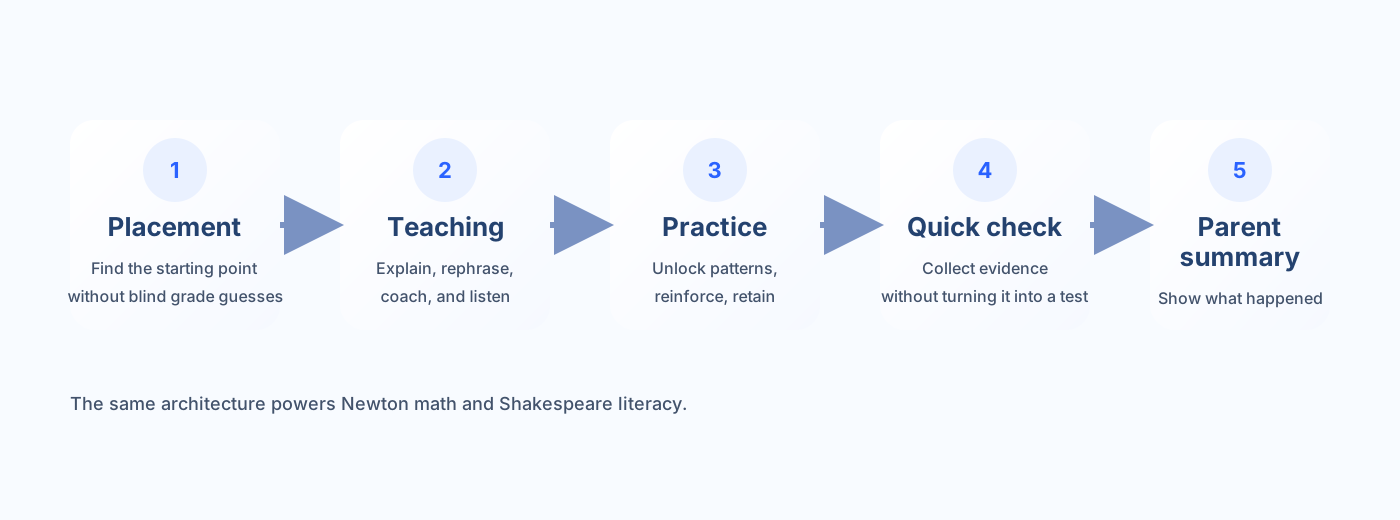
A Lesson is a focused skill or concept. Students move through Sessions, Practice, Mastery Checks, and a parent-visible Mastery Map.
Available now means families can use the House in the school today. Planned Houses are part of the future school map and are not live yet.
Available now
Live Academic Houses
Live
Live
House of Mathematics
AI Tutor: Newton
Students learn math foundations, fractions, ratios, early algebra, Practice, and Mastery Checks.
Math foundations
Fractions
Ratios
Early algebra
Practice and Mastery Checks
Live
House of Letters
AI Tutor: Shakespeare
Students learn reading, spelling, vocabulary, word work, grammar foundations, and early writing support.
Reading
Spelling
Vocabulary
Word work
Grammar foundations
Early writing support
Coming later
Planned Academic Houses
Planned
House of Reason and Philosophy
A future House for questioning, ethics, logic, argument, and practical wisdom.
Future House
Foundations of Questioning
Logic and Argument
Ethics and the Good Life
Political Philosophy
House of Science and Natural Philosophy
A future House for scientific thinking, physics, chemistry, biology, earth science, and astronomy.
Future House
Scientific Thinking
Physics: Motion and Force
Chemistry
Biology
Earth Science
Astronomy
House of Computer Science and Systems
A future House for computational thinking, programming, algorithms, systems, networks, and tools for thought.
Future House
Computational Thinking
Programming I
Software Design
Algorithms and Data Structures
Networks and Distributed Systems
House of History, Civilization, and Civics
A future House for history, civic life, constitutional thinking, statesmanship, and historical biography.
Future House
World History
American History
Constitution and Republic
Statesmanship
Historical Biography
House of Geography and the World
A future House for place, land, maps, regions, human settlement, and the wider world.
Future House
Physical Geography
Human Geography
Maps and Spatial Thinking
Exploration and World Encounter
Geopolitics and Borders
House of Art, Music, and Design
A future House for drawing, observation, composition, music theory, creative practice, and art history.
Future House
Drawing and Observation
Composition and Design
Music Theory
Creative Practice
Art History
House of Economics, Enterprise, and Stewardship
A future House for value, incentives, markets, credit, enterprise, and responsible stewardship.
Future House
Household Economy and Stewardship
Markets and Incentives
Money, Banking, and Credit
Entrepreneurship and Enterprise
Political Economy
House of Law, Justice, and Public Reason
A future House for rules, rights, duties, evidence, cases, debate, and public reason.
Future House
Introduction to Law and Justice
Reasoning from Cases
Rights, Duties, and Liberty
Debate, Evidence, and Procedure
House of Character and Leadership
A future House for habits, discipline, courage, service, friendship, responsibility, and leadership.
Future House
Habits and Discipline
Leadership and Command
Friendship and Community
Service and Conscience
Courage and Moral Witness
Faculty Guides
Human oversight
Faculty Guides are degreed human educators who oversee student progress, review tutor activity, help families understand results, and step in when a student needs human support.
Faculty Guides review learning patterns and support families.
Parents remain in control of consent, records, and support requests.
Future Deans will provide senior academic and administrative leadership.
AI Tutors
Daily guided instruction
AI Tutors handle daily guided instruction, Practice, hints, rephrasing, and Mastery Checks inside the learning system.
Newton is live for Mathematics. Shakespeare is live for Letters.
Tutor names are inspired by historical figures and intellectual traditions. They are not simulations of real people.
Student path
How a student moves through The Plato School
Here is the simple path. A student begins inside a House, works through Courses and Lessons,
meets with an AI Tutor in Sessions, practices when needed, and moves forward when a Mastery Check shows readiness.
Parents can follow the whole path on the Mastery Map.
1
House
The big subject area, like Math or Reading.
In other systems, this may be called a subject or department.
2
Course
A group of related things to learn inside that subject.
In other systems, this may be called a unit or learning path.
3
Lesson
One small thing the student is learning.
In other systems, this may be called a topic or module.
4
Session
One time working with the AI Tutor. One Lesson may take one Session or many Sessions. Sessions are part of the learning process, not separate charges or purchases. The tutor keeps the same personality, tone, and teaching style across Sessions so the student can build familiarity and trust.
In other systems, this may be called a class, meeting, or tutoring session.
5
Practice
Short extra work to help it stick.
In other systems, this may be called review, drill, exercise, or independent practice.
6
Mastery Check
A quick way to see if the student is ready to move on.
In other systems, this may be called a quiz, assessment, checkpoint, or skill check.
7
Mastery Map
A simple view showing what the student has mastered and what comes next.
In other systems, this may be called a progress tracker, learning map, or student progress view.
Some students may need one Session for a Lesson, and others may need several.
Plato allows as many Sessions as needed for mastery. Sessions are not separate purchases or charges,
and students are not rushed through fixed session counts. A Faculty Guide reviews progress in the background
and helps watch for mastery, patterns, and support needs.